
How Court Records After a Jail Arrest Work in Montgomery County
A person arrested in Dayton or elsewhere in Montgomery County may be booked at the Montgomery County Jail before a formal criminal case is fully visible online. The jail roster is a custody tool. The court record starts with a complaint, ticket, information, indictment, or related filing, depending on the offense and the court. The Montgomery County Clerk of Courts Public Records Online system, commonly called PRO, is the county-level path for Common Pleas criminal records, county municipal criminal records, civil records, domestic relations records, and Second District appellate records maintained by the Clerk.
That distinction matters when comparing court records after a jail arrest with jail inmate records. Sheriff Rob Streck's jail roster can help confirm present custody, the provider code MONT-JAIL, the Montgomery County Jail phone listing, and roster update timing. Court records identify the filed charges, court dates, docket entries, bond orders, warrants, dispositions, and copy options. Booking photos and photo-request issues belong with jail mugshots, not with the court case file.
Search Court Records After an Arrest: PRO and Dayton Municipal Court
The main county case-search source is Montgomery County Clerk PRO. The Clerk's public record statement says the Clerk is keeper of the record for legal documents filed in the covered courts, and that court documents are public records unless a restriction applies. PRO is useful for checking whether a jail arrest has become a Common Pleas criminal case, a county municipal criminal case, or another docket entry in the Clerk's system.
The Clerk PRO landing page is the source shown below, including the public-record disclaimer and access notice at the entry point.
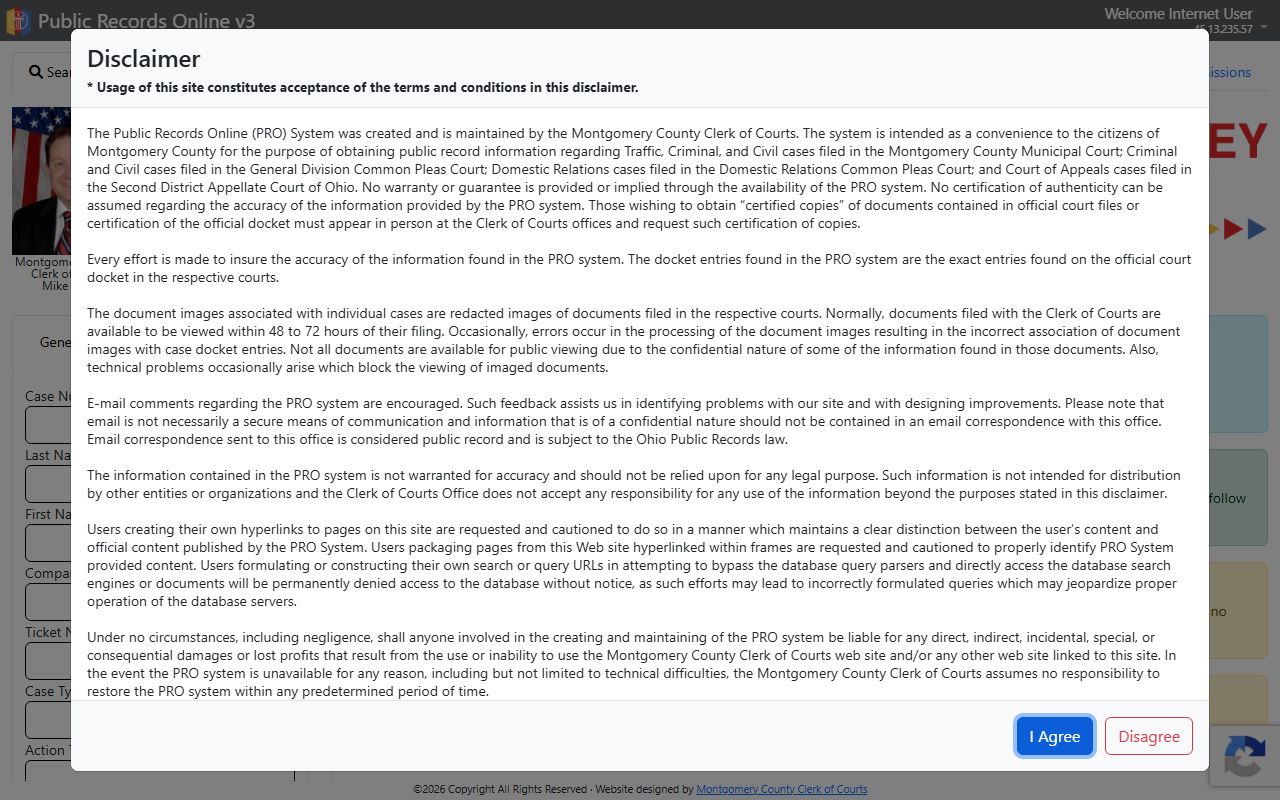
Use the PRO record as a court source, then compare it to jail and bond information because the arrest charge shown at booking can differ from the filed court charge.
- Open the Clerk's Public Records Online portal and review the disclaimer before relying on a docket entry.
- Search by defendant name or case number if that number appears on bond paperwork, a citation, a jail notice, or a court notice.
- Open the case docket and read every charge line separately. One arrest can produce multiple counts with different levels and statuses.
- Check the docket for bond entries, capias or warrant entries, continuances, preliminary-hearing activity, indictment, dismissal, plea, sentence, and disposition.
Dayton arrests often require a second search. Dayton Municipal Court is a limited-jurisdiction court of record for Dayton ordinance violations, Ohio statutory misdemeanor and traffic violations committed in Dayton, and preliminary hearings for Dayton felony cases. Its search menu includes Case Number, Filing Date, Ticket Number, Defendant Information, Defense Attorney, and Forms & Costs. If a Dayton Police arrest is not immediately visible in PRO, check Dayton Municipal Court for the municipal case or felony preliminary-hearing path.
Felony Intake, Preliminary Hearings, and Grand Jury Records
Ohio uses county prosecuting attorneys, not district attorneys. Montgomery County Prosecuting Attorney Mat Heck, Jr. is the county prosecutor, and the Criminal Division handles felony prosecution throughout Montgomery County. The official Criminal Division page says the office reviews more than 6,000 cases submitted each year for filing as felonies by law-enforcement agencies. It also describes an intake section that handles preliminary-hearing and grand-jury matters.
The prosecutor source for felony intake and grand jury work is Montgomery County Prosecutor Criminal Division.
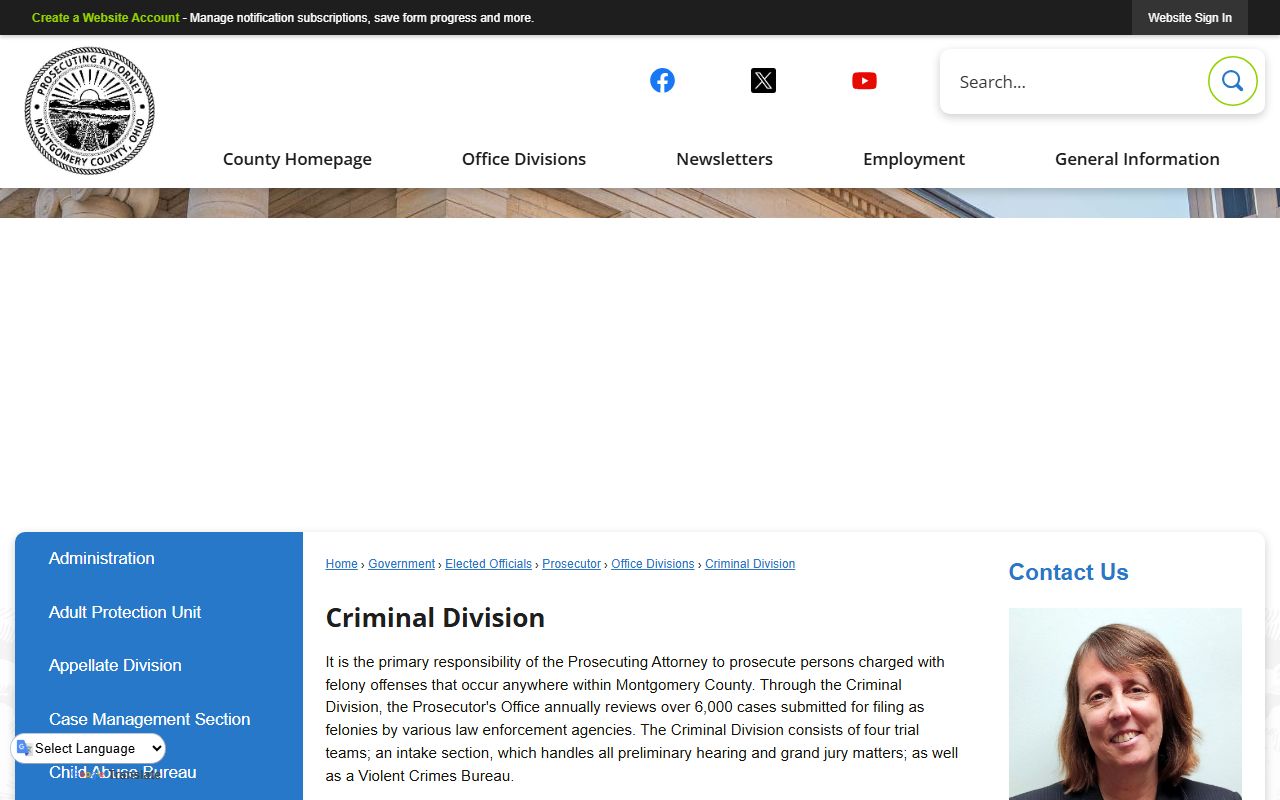
For a felony arrest, the first public case may appear in a municipal or county court for an initial appearance or preliminary hearing. Later entries may show bindover, grand jury review, indictment, and a Common Pleas case. This is why a court records after arrest search should be repeated after a few days when a very recent felony booking has not yet produced a complete Common Pleas docket.
Charging Documents After an Arrest: Complaint, Information, and Indictment
After booking, the formal court record begins with a charging document or citation filed in the proper court. A complaint often starts a misdemeanor case or a preliminary felony path. An information is a prosecutor-filed charging document used in some felony procedures, often when indictment is waived or the law permits that route. An indictment is a grand-jury charging document, and in Montgomery County felony cases it is tied to the prosecutor's intake and grand-jury process.
| Document | Who Files or Returns It | Common Montgomery County Use | What to Check |
|---|---|---|---|
| Complaint | Law-enforcement officer, prosecutor, or court filing process | Municipal misdemeanors, traffic-criminal matters, and felony preliminary paths | Filing date, statute, charge level, and first appearance or preliminary-hearing date |
| Information | Prosecutor | Felony prosecution when procedure allows or indictment is waived | Whether the defendant waived indictment and how the charge differs from arrest allegations |
| Indictment | Grand jury | Felony charges after prosecutor review and grand-jury presentation | Count numbers, felony degree, Common Pleas case number, arraignment, and bond orders |
Charge Status in Court Records After a Jail Arrest
Charges can change after the arrest. A roster may reflect the allegation at booking, but the prosecutor can file different charges, fewer charges, added charges, amended charges, or no charge. The docket is the better source for court status because it records filings, motions, entries, warrants, bond changes, pleas, dismissals, and final dispositions.
| Status | What It Means | Why It Matters |
|---|---|---|
| Pending | The charge or case has not reached final disposition. | Future court dates, bond conditions, warrants, and amendments may still change the record. |
| Amended / Reduced | The filed charge changed by prosecutor or court action. | The final court charge may be less serious, more specific, or otherwise different from the arrest allegation. |
| Dismissed | The charge ended without conviction. | A dismissal is not the same as a conviction, but the record may remain visible unless later sealed or expunged. |
| Nolle Prosequi | The prosecutor did not proceed with that charge. | The entry ends that charge without a conviction, subject to the exact docket language and court order. |
| Convicted / Guilty | The defendant entered a guilty plea or was found guilty. | The conviction, sentence, fines, jail credit, probation, or prison commitment should be read separately from dismissed counts. |
Bond Entries and Release Records After an Arrest
Bond is usually set by a court or magistrate at an initial appearance or other hearing. Montgomery County Jail publishes one very practical local instruction: bond may be posted 24 hours a day, seven days a week at the Inmate's Property Room Window in the jail lobby. The jail directs the public to call (937) 224-8447 to check bond amounts. The jail also warns that Ohio House Bill 1 requires a bail surcharge in addition to bond and court costs, that the surcharge can be as much as $85 for each bond, and that personal checks cannot be accepted for bond.
| Bond Type | How It Works | Montgomery County Note |
|---|---|---|
| Cash Bond | Money is paid directly to secure release while the case continues. | Call (937) 224-8447 before going to the jail to confirm the current amount and payment rules. |
| Surety Bond | A licensed bail agent posts bond for a fee. | The court and jail records should still be checked for conditions, holds, and court dates. |
| PR / Own Recognizance | The court releases the person based on a promise to appear, often with conditions. | The jail does not create this status on its own. Look for the court order or docket entry. |
| No-Bond Hold | Payment of ordinary bond will not release the person. | A warrant, probation, parole, federal, ICE, or other-agency hold can prevent release. |
Warrants That Lead to Arrest and Court Records
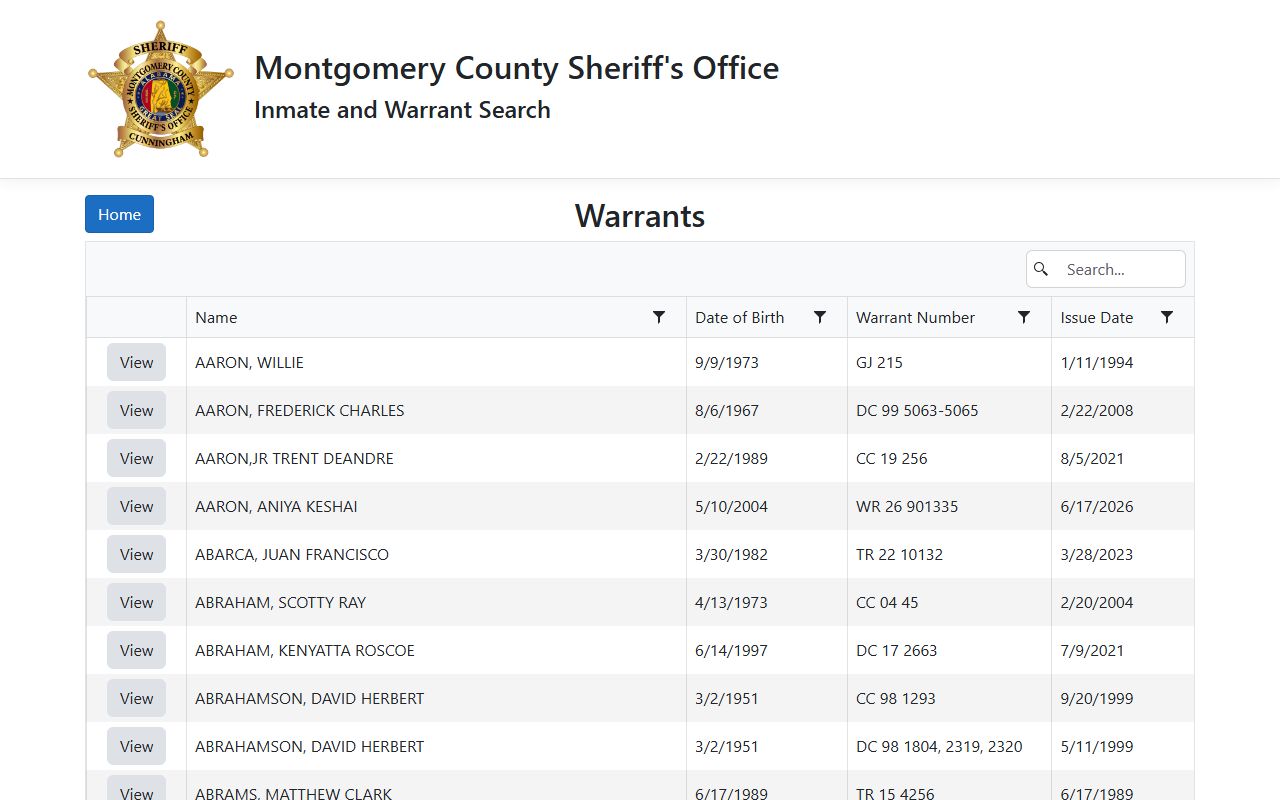
Montgomery County has a separate sheriff warrant portal at Inmate and Warrant Search - Montgomery County Sheriff's Office. The warrant page allows searching by name or case number and requires human verification. Name search fields include last name, first name, and optional middle initial. A warrant can exist before a person is in jail. Once law enforcement serves the warrant and the person is booked, the roster may update after intake, and the court docket may show warrant, capias, recall, bond, or failure-to-appear entries.
The sheriff warrant search page is shown below as the official warrant-specific source.
Common Pleas warrant questions can also be routed through the court side. The Common Pleas Court FAQ publishes the court phone number 937-225-6000 and lists the Montgomery County Courts Building at 41 N. Perry Street, Dayton, OH 45422, and the Reibold Building at 114 South Main Street, Dayton, OH 45402. Court hours are Monday through Friday, 8:30 a.m. to 4:30 p.m.
Copy Requests, Certified Copies, Redactions, and Online Limits
The Clerk public-record statement is important when using online court records after an arrest. PRO is a convenience source, not a certification source. The Clerk says no warranty or certification is implied by PRO. Certified copies require appearing in the Clerk offices. Document images are redacted and are normally available within 48 to 72 hours after filing. Some images may not be publicly viewable because of confidential information or technical/image issues.
For ordinary copies, the research states that regular copies cost $0.10 per page in the Clerk's office, while certified and authenticated copies are separate types. Municipal court copy requests can be made in person, by phone, fax, or mail at the proper location. Redactions may affect Social Security numbers, protected addresses, victim information, juvenile information, confidential law-enforcement material, medical information, and other categories protected by Ohio law or court rule.
Charges vs. Convictions in Arrest Court Records
An arrest and a filed charge are accusations, not proof of guilt. A conviction requires a guilty plea, finding, or judgment. When reading Montgomery County court records after arrest, check each count separately because one count may be dismissed while another is amended or resolved by plea.
| Charge | Conviction | |
|---|---|---|
| Stage | Accusation filed in court after arrest, citation, warrant, or prosecutor review | Final finding, guilty plea, or judgment on a count |
| Proof Standard | Often starts from probable cause or charging review | Requires proof beyond a reasonable doubt or a valid plea |
| Record Meaning | Shows what was alleged and filed | Shows legal responsibility and may support sentence, supervision, or ODRC commitment |
Sealed vs. Expunged Court Records After an Arrest
Ohio Revised Code 2953.32 governs applications to seal or expunge eligible conviction records. A court order is required. Sealing generally restricts ordinary public access to an official court record. Expungement is a stronger remedy for eligible records and is treated differently under Ohio law. Eligibility depends on the case type, disposition, timing, criminal history, and statutory exclusions, so the docket alone does not prove whether a record can be cleared.
| Sealed | Expunged | |
|---|---|---|
| Public Visibility | Restricted from ordinary public access after court order | Removed or treated as expunged under the court order and applicable Ohio law |
| Official Access | Limited official access may remain for law-enforcement, court, or statutory purposes | Access is more restricted, but exact treatment depends on the order and law |
| Montgomery County Path | File in the court that controls the eligible case record | File in the court that controls the eligible case record and request expungement if available |
Background Check Considerations
Casual court lookup and regulated background screening are different activities. A docket search may help identify a case number, charge status, bond entry, or disposition, but employment, tenant, credit, insurance, and similar screening must follow the Fair Credit Reporting Act and any other governing law. Court records after arrest can also be incomplete if the case is new, sealed, expunged, redacted, or still awaiting prosecutor action.
Important: Montgomery County Inmate Population is not a consumer reporting agency and court or jail information may not be used for FCRA-covered screening.
Restricted Court Records After an Arrest in Montgomery County
Ohio Revised Code 149.43 starts from public inspection and copying of public records, but it includes exceptions. Criminal and court records can be affected by confidential law-enforcement investigatory material, juvenile records, protected victim and witness information, medical information, sealed records, protection-order identity restrictions, restricted officer or personal information, and other statutory or court-rule limits. ODRC records have their own rule under ORC 5120.21, which is why state-prison inmate records differ from county jail and court files.
For a fresh arrest, the most accurate workflow is to check custody first, then search the proper court, then confirm copies or certification with the Clerk or municipal court. A case that is missing online may still exist at the clerk's office, may be too new, may be in another court, or may be restricted from online display.